
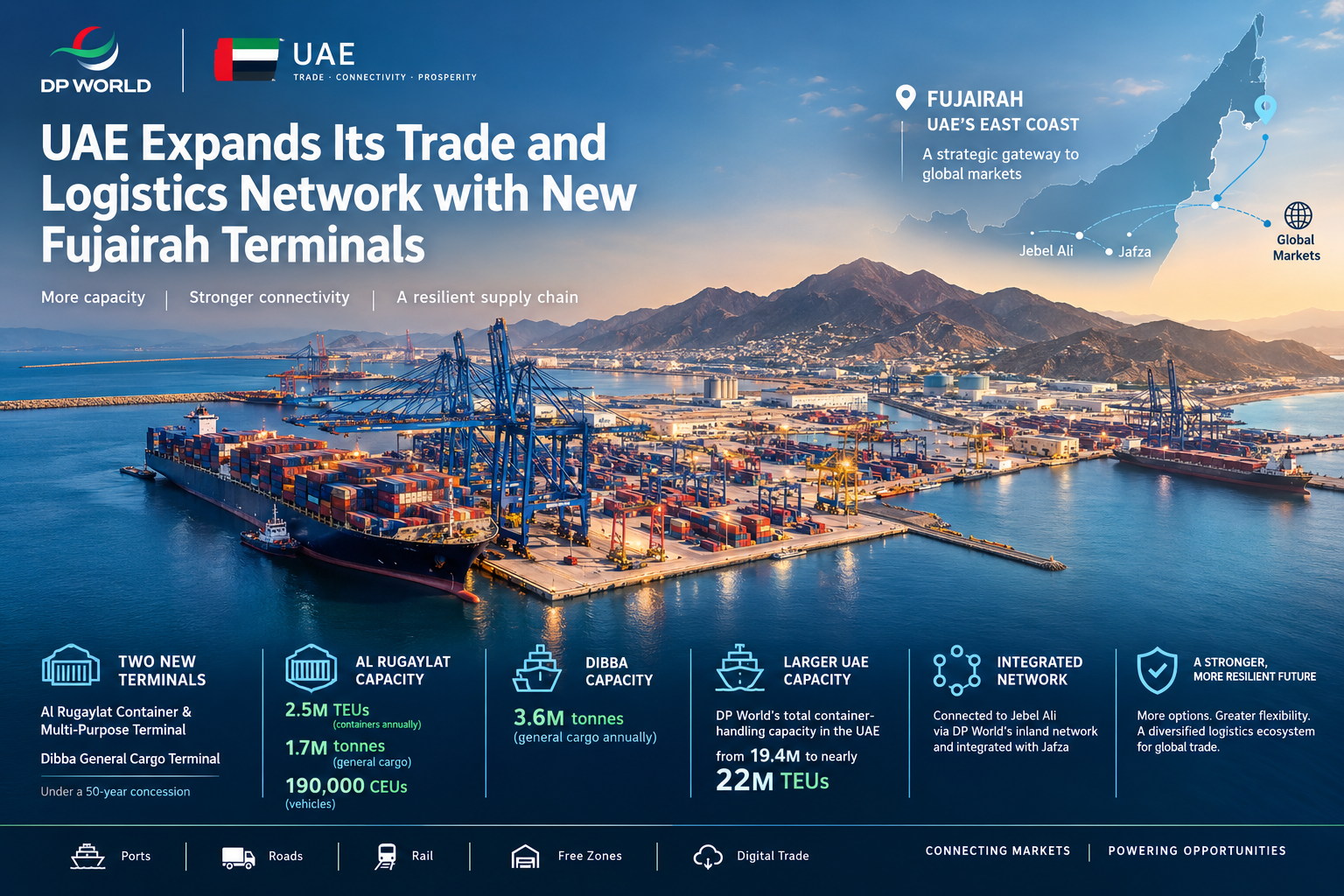
The United Arab Emirates is strengthening its position as a global trade and logistics hub through a major expansion of its maritime infrastructure. DP World has reached an agreement in principle with the Fujairah Ports Authority to develop two new terminals on the UAE’s east coast, creating additional capacity and strengthening connections between the country’s ports, logistics zones and international markets.
The project represents another major step in the UAE’s long-term strategy to enhance trade connectivity and build a more resilient supply chain network.
Two New Terminals in Fujairah
Under the proposed 50-year concession, DP World plans to develop two facilities: the Al Rugaylat Container and Multi-Purpose Terminal and the Dibba General Cargo Terminal.
The Al Rugaylat terminal is designed to handle up to 2.5 million TEUs of containers annually, in addition to approximately 1.7 million tonnes of general cargo and 190,000 car equivalent units.
The Dibba terminal will add up to 3.6 million tonnes of annual general cargo capacity.
The new infrastructure is expected to create an additional deep-water gateway on the UAE’s east coast, capable of handling the latest generation of large container vessels.
Strengthening the UAE’s Maritime Connectivity
Fujairah’s strategic location on the Gulf of Oman gives the new terminals an important role within the UAE’s wider maritime network.
The facilities will be connected to Jebel Ali through DP World’s inland logistics network and integrated with Jafza, creating a broader end-to-end supply chain connecting ports, logistics hubs and commercial markets.
Once operational, the development is expected to increase DP World’s total container-handling capacity in the UAE from approximately 19.4 million TEUs to nearly 22 million TEUs.
This expansion will also increase the UAE’s capabilities in general cargo and roll-on/roll-off transportation.
Supporting Supply Chain Resilience
Global supply chains are becoming increasingly complex, with businesses seeking greater flexibility, alternative transportation routes and reliable logistics infrastructure.
The Fujairah development is designed to provide cargo owners with additional options for moving goods through the UAE and connecting with regional and international markets.
By linking Fujairah with Jebel Ali and the wider logistics network, the project will allow businesses to benefit from a more integrated transportation system covering maritime, road and inland logistics.
This approach is increasingly important as companies look to reduce supply chain risks and improve the speed and reliability of cargo movement.
A Broader Logistics Strategy
The Fujairah project forms part of a wider expansion of the UAE’s logistics infrastructure.
Dubai’s Jebel Ali Port remains a major anchor of the country’s international trade network, while investments in road, rail, free zones and digital customs systems are helping create an integrated logistics ecosystem.
In recent months, DP World has also expanded its regional road freight capabilities, while Dubai Customs has introduced initiatives aimed at maintaining trade flows and improving supply chain resilience.
Together, these developments demonstrate how the UAE is combining ports, free zones, road networks, rail infrastructure and digital technologies to support international commerce.
Fujairah’s Growing Role in Global Trade
The new terminals could further strengthen Fujairah’s position as an important maritime gateway.
Located outside the Strait of Hormuz on the Gulf of Oman, Fujairah already plays a significant role in regional shipping, fuel services and maritime activities.
Additional container and general cargo capacity could attract new trade flows, encourage investment and support the development of logistics and industrial activities in the emirate.
The project is expected to be delivered in phases, with construction anticipated to take approximately 24 to 30 months from commencement.
Looking Ahead
The expansion of Fujairah’s port infrastructure highlights the UAE’s continued investment in the future of global trade.
As international supply chains evolve, countries and businesses are placing greater importance on connectivity, capacity and resilience. The UAE is responding by developing a diversified logistics network that connects maritime gateways with free zones, road transport, rail and digital trade systems.
With the planned Fujairah terminals, the UAE will add further capacity to an already extensive logistics ecosystem and strengthen its role as a strategic gateway between global markets.
For businesses operating across the Middle East, Asia, Africa and Europe, these developments could provide additional opportunities to use the UAE as a base for international trade, distribution and supply chain operations.
The United Arab Emirates is strengthening its position as a global trade and logistics hub through a major expansion of its maritime infrastructure. DP World has reached an agreement in principle with the Fujairah Ports Authority to develop two new terminals on the UAE’s east coast, creating additional capacity and strengthening connections between the country’s ports, logistics zones and international markets.
The project represents another major step in the UAE’s long-term strategy to enhance trade connectivity and build a more resilient supply chain network.
Two New Terminals in Fujairah
Under the proposed 50-year concession, DP World plans to develop two facilities: the Al Rugaylat Container and Multi-Purpose Terminal and the Dibba General Cargo Terminal.
The Al Rugaylat terminal is designed to handle up to 2.5 million TEUs of containers annually, in addition to approximately 1.7 million tonnes of general cargo and 190,000 car equivalent units.
The Dibba terminal will add up to 3.6 million tonnes of annual general cargo capacity.
The new infrastructure is expected to create an additional deep-water gateway on the UAE’s east coast, capable of handling the latest generation of large container vessels.
Strengthening the UAE’s Maritime Connectivity
Fujairah’s strategic location on the Gulf of Oman gives the new terminals an important role within the UAE’s wider maritime network.
The facilities will be connected to Jebel Ali through DP World’s inland logistics network and integrated with Jafza, creating a broader end-to-end supply chain connecting ports, logistics hubs and commercial markets.
Once operational, the development is expected to increase DP World’s total container-handling capacity in the UAE from approximately 19.4 million TEUs to nearly 22 million TEUs.
This expansion will also increase the UAE’s capabilities in general cargo and roll-on/roll-off transportation.
Supporting Supply Chain Resilience
Global supply chains are becoming increasingly complex, with businesses seeking greater flexibility, alternative transportation routes and reliable logistics infrastructure.
The Fujairah development is designed to provide cargo owners with additional options for moving goods through the UAE and connecting with regional and international markets.
By linking Fujairah with Jebel Ali and the wider logistics network, the project will allow businesses to benefit from a more integrated transportation system covering maritime, road and inland logistics.
This approach is increasingly important as companies look to reduce supply chain risks and improve the speed and reliability of cargo movement.
A Broader Logistics Strategy
The Fujairah project forms part of a wider expansion of the UAE’s logistics infrastructure.
Dubai’s Jebel Ali Port remains a major anchor of the country’s international trade network, while investments in road, rail, free zones and digital customs systems are helping create an integrated logistics ecosystem.
In recent months, DP World has also expanded its regional road freight capabilities, while Dubai Customs has introduced initiatives aimed at maintaining trade flows and improving supply chain resilience.
Together, these developments demonstrate how the UAE is combining ports, free zones, road networks, rail infrastructure and digital technologies to support international commerce.
Fujairah’s Growing Role in Global Trade
The new terminals could further strengthen Fujairah’s position as an important maritime gateway.
Located outside the Strait of Hormuz on the Gulf of Oman, Fujairah already plays a significant role in regional shipping, fuel services and maritime activities.
Additional container and general cargo capacity could attract new trade flows, encourage investment and support the development of logistics and industrial activities in the emirate.
The project is expected to be delivered in phases, with construction anticipated to take approximately 24 to 30 months from commencement.
Looking Ahead
The expansion of Fujairah’s port infrastructure highlights the UAE’s continued investment in the future of global trade.
As international supply chains evolve, countries and businesses are placing greater importance on connectivity, capacity and resilience. The UAE is responding by developing a diversified logistics network that connects maritime gateways with free zones, road transport, rail and digital trade systems.
With the planned Fujairah terminals, the UAE will add further capacity to an already extensive logistics ecosystem and strengthen its role as a strategic gateway between global markets.
For businesses operating across the Middle East, Asia, Africa and Europe, these developments could provide additional opportunities to use the UAE as a base for international trade, distribution and supply chain operations.
Sources:
المصدر الخاص بالمقال