
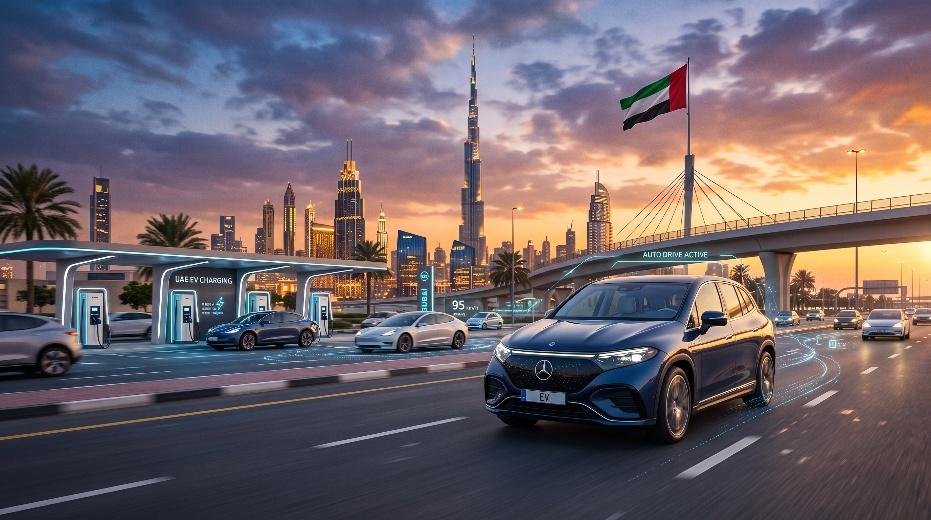
The automotive sector in the United Arab Emirates is entering a significant new phase in 2026. While conventional petrol-powered vehicles continue to play an important role in the market, electric vehicles, connected technologies and autonomous mobility are rapidly changing the way people and businesses think about transportation.
The UAE’s combination of advanced infrastructure, strong consumer purchasing power, ambitious sustainability targets and government investment in smart mobility is creating an increasingly attractive environment for automotive manufacturers, technology companies and mobility investors

A Changing Automotive Landscape
The UAE has traditionally been one of the Middle East’s most important automotive markets, supported by a strong demand for passenger vehicles, SUVs, luxury cars and commercial vehicles.
However, the market is now evolving beyond traditional vehicle ownership.
Consumers are becoming increasingly interested in electric and hybrid vehicles, while manufacturers are introducing new models equipped with advanced driver-assistance systems, connected services and artificial intelligence.
This transformation is being supported by national policies designed to encourage cleaner and smarter transportation.
According to the UAE Ministry of Energy and Infrastructure, the country ranked first in the Middle East for electric vehicle sales for the second consecutive year in 2026, accounting for nearly half of regional EV sales.
Electric Vehicles Gain Momentum
Electric vehicles are becoming one of the most important growth areas in the UAE automotive market.
The National Electric Vehicles Policy aims to accelerate EV adoption, develop a nationwide charging network and encourage investment in sustainable mobility solutions.
The UAE has also established a long-term ambition for electric and hybrid vehicles to account for 50% of vehicles on the country’s roads by 2050.
The shift is already visible in consumer behaviour. According to the 2026 Global Electric Mobility Readiness Index cited by WAM, EVs represented around 9% of new vehicle sales in the UAE in 2025.
As more international manufacturers introduce electric models across different price segments, consumers in the UAE are gaining access to a wider range of choices, from premium electric SUVs and performance vehicles to more affordable urban models.
Charging Infrastructure Becomes a Key Priority
The expansion of electric vehicles depends heavily on the availability of convenient and reliable charging infrastructure.
Across the UAE, governments and private-sector companies are investing in charging networks to support the growing number of electric vehicles on the roads.
The country had approximately 2,800 EV charging points according to the 2026 electric mobility readiness report cited by WAM.
Abu Dhabi is also developing its charging infrastructure as part of its wider low- and zero-emission mobility strategy. The emirate is targeting 50% zero-emission vehicles by 2040 and has outlined significant future expansion of charging points across Abu Dhabi, Al Ain and Al Dhafra.
Dubai, meanwhile, continues to expand its EV charging ecosystem through DEWA’s EV Green Charger network.
The development of charging infrastructure is becoming an increasingly important factor in consumer confidence and the future growth of electric mobility.
The Rise of Smart and Autonomous Vehicles
The future of the UAE automotive industry extends beyond electrification.
Artificial intelligence, advanced sensors, connectivity and autonomous-driving technologies are becoming increasingly important components of the mobility ecosystem.
Abu Dhabi’s Smart and Autonomous Vehicle Industry (SAVI) cluster is designed to position the emirate as a global hub for the development of smart and autonomous vehicles.
The initiative covers land, air and sea mobility and focuses on technologies including LiDAR, advanced sensor fusion, vehicle-to-everything communication, solid-state batteries, 5G connectivity and AI-powered predictive maintenance.
The SAVI cluster is expected to contribute between AED 90 billion and AED 120 billion to the UAE economy and create between 30,000 and 50,000 jobs.
This represents a broader shift from the traditional automotive industry toward a technology-driven mobility sector.
Luxury and Premium Cars Remain Important
Despite the rapid growth of electric and smart mobility, luxury vehicles remain an important part of the UAE automotive landscape.
Dubai and Abu Dhabi have established themselves as major regional markets for premium and performance vehicles, supported by high consumer demand, strong tourism activity and the country’s position as an international business hub.
Luxury manufacturers are increasingly combining traditional performance and premium design with electrification.
As a result, the UAE market is becoming an important testing ground for new electric luxury vehicles, high-performance EVs and technologically advanced models.
Automotive Technology and the Connected Car
Another major trend shaping the UAE automotive market in 2026 is vehicle connectivity.
Modern vehicles increasingly function as connected digital platforms rather than simply transportation tools.
Features such as advanced navigation, remote vehicle management, over-the-air software updates, digital dashboards, driver-assistance systems and AI-powered safety technologies are becoming increasingly common.
For manufacturers, connectivity creates opportunities to develop new services and improve customer relationships. For consumers, it means vehicles are becoming more integrated with their digital lifestyles.
Opportunities for Automotive Investment
The transformation of the automotive sector is also creating new investment opportunities.
Growth is no longer limited to vehicle manufacturing and dealerships. Opportunities are emerging across EV charging infrastructure, automotive software, batteries, autonomous-driving technology, vehicle data, fleet management and smart mobility services.
The UAE’s strategic location between major Asian, European and African markets also supports its role as a regional distribution and logistics centre for automotive companies.
Government initiatives such as the SAVI cluster further strengthen the country’s position as an emerging centre for mobility technology and research.
What the UAE Automotive Market Could Look Like Next
The UAE automotive industry is moving toward a more diversified mobility ecosystem.
Petrol-powered vehicles will remain part of the market, but electric vehicles, hybrids, autonomous technologies and connected mobility are expected to play an increasingly important role.
For automotive companies, success in the UAE will increasingly depend on their ability to combine performance, technology, sustainability and customer experience.
For consumers, the next few years are likely to bring greater vehicle choice, more charging infrastructure and increasingly advanced automotive technologies.
The Road Ahead
The UAE automotive sector in 2026 reflects the country’s broader transformation toward a technology-driven and sustainable economy.
From electric vehicles and charging networks to autonomous mobility and connected cars, the automotive industry is becoming closely linked with energy, artificial intelligence, infrastructure and digital technology.
With strong government support and continued private-sector investment, the UAE is positioning itself not simply as a major market for cars, but as a regional hub for the future of mobility.