
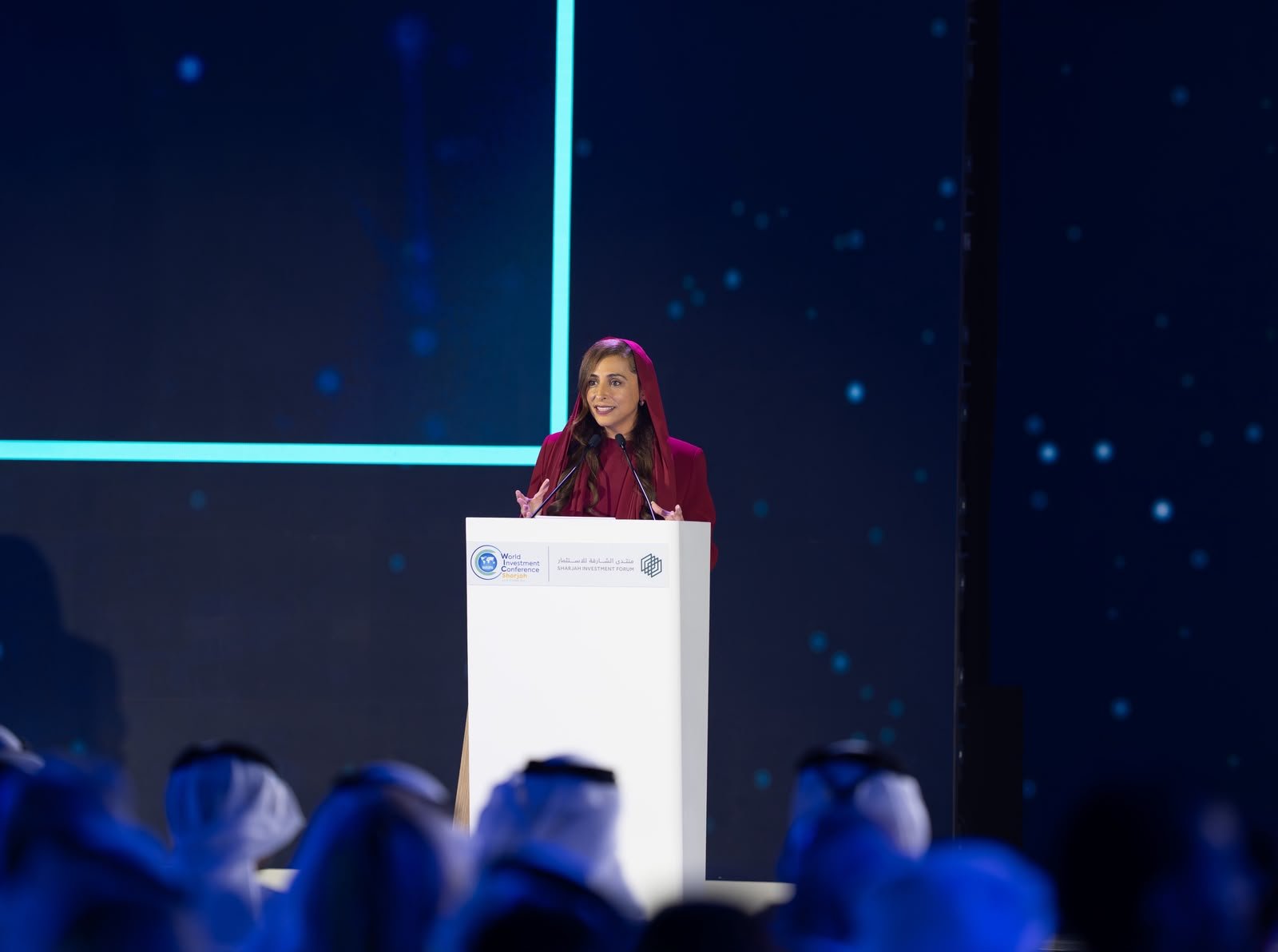
Building Adaptive Economies
- In your view, what does it truly mean to build an “adaptive economy” today, especially in a world shaped by rapid technological change, shifting investment flows, and evolving social priorities?
In Sharjah, we see an adaptive economy as one that has the confidence and capacity to respond to change while continuing to create opportunities for people.
That requires strong institutions, forward-looking policies, economic diversification and an openness to innovation. It also requires continuous investment in people, because technology, capital and emerging industries can create lasting value only when societies have the knowledge and skills to make the most of them.
For me, adaptability is ultimately about long-term capability. Capability matters more than prediction. No one can foresee every change, but an economy can build the ability to anticipate it, respond to disruption and keep evolving without losing sight of the people we serve or the values and identity that guide us.
That is what makes an economy resilient and ready for what comes next.
Knowledge as Economic Strength
- You have often championed education, books, and access to knowledge as foundations for progress. How can knowledge and lifelong learning become practical drivers of economic resilience, not only cultural or academic development?
Knowledge is an economic strength when it becomes part of how people live, work, solve problems and make decisions.
Education and lifelong learning give people the ability to adapt as industries change. Reading, research and access to trusted knowledge strengthen curiosity, critical thinking and judgment, while helping entrepreneurs, businesses and policymakers make better choices.
This matters because no one can say which skills, technologies or sectors will define the next decade. What we can do is build people’s capacity to keep learning and keep pace with change.
Learning, therefore, cannot end with a degree. It must continue through professional development, entrepreneurship, research, reading and the exchange of ideas.
Economies that consistently invest in knowledgeable, curious and adaptable people create new opportunities and remain resilient over time.
Leadership in Times of Change
- When economies and societies face uncertainty, what qualities do leaders need most: speed, patience, courage, empathy, innovation, or something else? How do you personally define responsible leadership in such moments?
It depends on how we define uncertainty. The future is always uncertain. What changes is the scale and speed of the forces shaping it. A leader cannot eliminate uncertainty, so the role is to help people navigate it with clarity, confidence and purpose.
Growing up watching His Highness Sheikh Dr. Sultan bin Mohammed Al Qasimi navigate complex regional and global shifts taught me that leadership in such moments requires courage, humility and patience: the courage to make difficult decisions, the humility to listen and learn, and the patience to think beyond the immediate moment and consider the consequences of those decisions over time.
It also requires empathy, because uncertainty does not affect everyone in the same way. Responsible leadership has to remain connected to people’s lived realities.
For me, leadership is ultimately about creating the conditions in which people can move forward, even when the path is not fully clear. It means communicating honestly, taking responsibility for difficult choices and remaining open to change. The strongest leaders do not need to have every answer. They build trust, draw on the wisdom around them and give others the confidence to help shape what comes next.
Sharjah’s Model of Development
- Sharjah has built a distinctive identity around culture, education, entrepreneurship, and human development. What do you believe makes this model especially relevant to the future of investment and sustainable growth?
In many ways, the world is now looking more closely at development models like the one Sharjah has pursued for decades, models in which economic growth is not treated as an end in itself, but as a means of improving people’s lives, strengthening communities and creating opportunity across generations.
Economists have long questioned the idea that growth can continue indefinitely without regard to its human and environmental consequences. Kenneth Boulding, for example, argued decades ago that no model based on endless growth can ignore the limits of the world in which it operates.
Sharjah’s approach reflects that understanding. When growth is connected to education, culture, environmental responsibility, entrepreneurship and human development, progress is measured not only by what an economy produces, but by what it enables people to become.
This approach also gives investors confidence. They look for more than returns. They need clarity of vision, institutional stability and trust in the direction a society is taking. When those elements are present, they can invest as partners in that future.
Education and Future Talent
- As President of American University of Sharjah, how do you see universities evolving to prepare graduates who are not only employable but also capable of shaping industries, communities, and economies with purpose?
This connects directly to your earlier question about uncertainty and leadership. Universities cannot prepare students for a future that is known in advance. What we can do is equip them with the skills, judgment and confidence to adapt and thrive as the landscape changes.
That means combining academic rigour with critical thinking, creativity, interdisciplinary collaboration and the capacity for lifelong learning.
Employability remains essential, but it should mean far more than securing a first job. Graduates should be equipped to create opportunities, contribute to meaningful research, launch new ventures and strengthen the communities around them.
At American University of Sharjah, we see education as an active partnership between the university, industry and society. Our responsibility is to prepare graduates for the future of work, while giving them the agency and sense of purpose to help shape it.
Culture and the Creative Economy
- Culture is sometimes viewed as a soft sector, yet it can create jobs, attract investment, strengthen identity, and connect communities. How do you see cultural industries contributing to future-ready economies?
Cultural and creative industries are now serious contributors to economic growth, trade and job creation. UNCTAD estimates that global exports of creative goods and services exceeded $2 trillion in 2024. That scale alone tells us that culture can no longer be treated as peripheral to the economy.
Creative and cultural industries generate employment, support entrepreneurship, attract investment and often stimulate innovation well beyond the cultural sector itself. They also create important pathways for participation, particularly for young people and women, because creative work can turn talent, ideas and cultural knowledge into economic opportunity.
In Sharjah, we recognised this early by making culture and the creative industries part of our wider development model. But their potential does not unlock itself. It requires the right environment, including strong protection for intellectual property, fair reward for creators, investment in local talent and meaningful international partnerships.
When those foundations are in place, culture becomes much more than a source of identity or expression. It becomes a driver of entrepreneurship, innovation, economic resilience and human development.
Books, Publishing, and Global Dialogue
- Your work in publishing and book culture has had strong regional and global influence. In a time of digital acceleration and artificial intelligence, how can books, reading, and publishing continue to shape critical thinking and social progress?
Adaptation and focus. I believe both are essential if books, reading and publishing are to continue playing their role in society.
Publishers have to adapt to technology, new formats and changing reading habits, whether people encounter books in print, digitally or through audio. But we must remain equally focused on why books matter in the first place.
In a world where information, including AI-generated content, can be produced and distributed almost instantly, the ability to think critically becomes even more important. Reading asks us to slow down, follow an argument, encounter perspectives different from our own and question what we think we know. Those habits are essential to informed societies.
Publishing has an important responsibility here as well. Publishers do more than produce content. They select, shape, question and edit, giving ideas the space to develop with depth and integrity. In an age of abundant information, that role becomes more valuable, not less.
Technology will continue to change how stories and knowledge reach us, and publishing should embrace that change. But the deeper purpose remains constant: to keep people reading, thinking, questioning and engaging with one another through ideas. That is how books continue to contribute to social progress.
Innovation with Human Value
- As emerging technologies transform the way people learn, work, invest, and communicate, how can societies ensure that innovation remains human-centred and inclusive rather than purely technical or commercial?
That is an important question. Innovation should be judged by whether it improves people’s lives and expands opportunity for everyone.
That means asking who benefits, who might be excluded, and what risks may emerge alongside efficiency and commercial value.
Inclusion matters because women, young entrepreneurs and underrepresented voices should also be shaping the digital landscape, not sitting at its margins. That requires equal access to skills and platforms, as well as the confidence to adapt to new technologies and to design, lead and govern them.
Governments, businesses, universities and communities all share a responsibility to guide innovation with ethics, transparency and accountability.
Technology will continue to change how we live and work. Our responsibility is to ensure that change and innovation remain guided by human values, advance inclusion and strengthen human potential.
Women, Entrepreneurship, and Economic Participation
- You have supported platforms and initiatives connected to women’s leadership and entrepreneurship. What more can be done to ensure women are not only included in economic development but also positioned as drivers of new growth?
As a starting point, we need to look honestly at what is still preventing women from participating fully in economic life and from driving new growth. The barriers are well documented. They include unequal access to finance and networks, gaps in legal and economic rights, limited access to assets and the disproportionate burden of unpaid care.
World Bank research shows that these remain structural challenges in many economies. Inclusion alone is therefore not enough. We have to remove the barriers that prevent women from building businesses, accessing capital, entering new markets and exercising real decision-making authority.
This is something I have tried to advance through different parts of my work, whether through the Sharjah Women Impact Fellowship at Sheraa, the Sheikha Jawaher bint Mohammed Al Qasimi Chair in Women’s Leadership at American University of Sharjah or PublisHer. Each of these initiatives, in different ways, is about creating more pathways for women to lead, build, influence and grow.
More broadly, we need women leading in the sectors that will shape future growth, including technology, scientific research, sustainability and the creative economy. Their participation at that level strengthens innovation because it brings different experiences, questions and priorities into the decisions being made.
Ultimately, this is an economic issue as much as a social one. When women have access to capital, opportunity and authority, we expand the pool of ideas, talent and enterprise available to an economy. That makes growth stronger, more dynamic and more resilient.
Partnership Between Public, Private, and Nonprofit Sectors
- Your work often bridges public, private, and nonprofit stakeholders. Why are multi-sector partnerships essential for building adaptive economies, and what makes these partnerships successful in practice?
No single sector can build an adaptive economy on its own. Governments provide direction and create the conditions for long-term investment. The private sector brings capital, innovation and the ability to scale. Nonprofit organisations often understand community needs at a very practical level and can reach people and places that larger institutions may miss.
The value of partnership comes from bringing those different strengths together. Collaboration is not achieved simply by placing organisations around the same table. It requires a shared objective, clarity about each partner’s role and a willingness to measure success by real outcomes rather than by the visibility of the partnership itself.
The strongest partnerships are built on trust, transparency and accountability. They allow each sector to contribute what it does best while remaining open to different forms of knowledge and experience. They also recognise that meaningful results take time and often require adjustment along the way.
When those conditions are present, partnerships can connect policy, investment and community needs much more effectively. They help turn good ideas into practical solutions and create results that are more relevant, more inclusive and more likely to endure.
Youth and the Future of Investment
- Young people are entering a world where careers, industries, and markets are changing quickly. What message would you share with the next generation about adaptability, responsibility, and their role in shaping the UAE’s future?
My message to young people in the UAE is that you are beginning your careers in a country that understands the scale of global change and is actively preparing for it. That is a remarkable opportunity.
Use it to build the skills, curiosity and confidence to keep learning, adapting and creating new possibilities. Carry the UAE’s ambition forward with responsibility, and stay grounded in the values that define our society. The industries, ideas and opportunities that will drive the country’s next chapter are yours to help shape.
A Personal Reflection on Legacy
- Looking ahead, what kind of legacy do you hope to help build through your work in education, culture, publishing, entrepreneurship, and development, and what would you like future generations to remember about this chapter of Sharjah’s journey?
We often read in history about moments when a city or a nation created something of lasting value for human progress, with an impact that reached far beyond its own time and borders. That is how I hope this chapter of Sharjah’s journey will be remembered.
I hope future generations see a society that remained deeply connected to its heritage, values and identity while opening itself confidently to the world, investing in knowledge, encouraging innovation and expanding human potential through education, culture, publishing and entrepreneurship.
What matters most is that the institutions, ideas and opportunities created during this period continue to serve people and inspire those who come after us. If future generations can build on this foundation, carry it forward and create something even greater, then that would be a legacy worth leaving behind.