
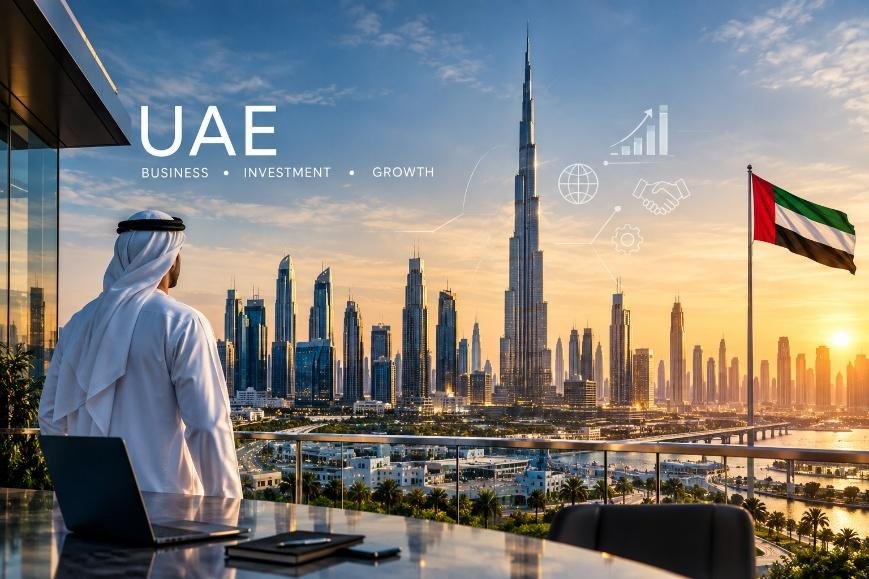
The United Arab Emirates continues to strengthen its position as one of the world’s most dynamic business and investment destinations. In 2026, the country’s economic model is increasingly defined by diversification, international investment, technology, infrastructure and a growing private sector, reinforcing its role as a global hub connecting businesses, investors and markets across the Middle East and beyond.
The UAE’s business environment has evolved significantly over the past decade. While oil and gas remain important to the national economy, non-oil activities now represent the majority of economic output. According to the UAE Ministry of Economy and Tourism, the country’s real GDP reached AED 1.776 trillion in 2024, growing by 4%, while non-oil GDP expanded by 5% to AED 1.342 trillion, representing 75.5% of total GDP.
A Diversified Economy Driving Business Growth
The strength of the UAE economy is increasingly visible across a wide range of sectors. Trade, manufacturing, financial services, construction, real estate, transport, tourism and hospitality have become important pillars of economic activity.
In 2024, transport and storage was among the fastest-growing sectors, supported by strong airport and logistics activity. Construction also recorded significant growth, while financial and insurance activities expanded by 7%. Real estate activity grew by 4.8%, reflecting continued demand for residential, commercial and investment assets.
This diversification provides businesses with opportunities beyond traditional energy-related industries. Companies operating in technology, finance, logistics, healthcare, manufacturing, tourism, real estate and professional services are increasingly becoming part of the UAE’s wider economic growth story.
The UAE’s Business Outlook for 2026
The International Monetary Fund has described the UAE’s economic outlook as strong, with growth supported by both hydrocarbon and non-hydrocarbon activity. Its earlier 2026 projection estimated real GDP growth of around 5%, with non-hydrocarbon growth at approximately 4.6%.
More recent IMF assessments in 2026 have highlighted the UAE economy’s resilience despite regional geopolitical and trade challenges. The country’s strong financial buffers, infrastructure, diversified economy and policy response continue to support economic stability.
For businesses, this resilience is particularly important. It creates an environment in which companies can plan for long-term expansion while responding to changing global market conditions.
Foreign Investment Remains a Major Growth Driver
Foreign direct investment continues to be one of the strongest indicators of international confidence in the UAE.
According to the UAE’s latest Foreign Direct Investment Report, the country attracted approximately US$48.3 billion, equivalent to AED177.3 billion, in FDI inflows during 2025. This represented a 6% increase compared with the previous year and marked the fourth consecutive year of record FDI inflows.
The UAE ranked ninth globally among destinations for inbound FDI and maintained its position as the world’s second-largest destination for greenfield projects, with 1,562 projects recorded in 2025.
The country’s National Investment Strategy 2031 aims to increase annual FDI inflows to AED240 billion and raise total FDI stock to AED2.2 trillion by 2031.
These figures demonstrate that the UAE is not simply attracting capital; it is building an investment ecosystem designed to support businesses, entrepreneurs and international companies over the long term.
Technology and Innovation at the Centre of Business
Technology is becoming increasingly important to the UAE’s business landscape. Artificial intelligence, automation, fintech, advanced manufacturing, digital services and smart infrastructure are creating new opportunities for both established companies and startups.
The UAE is also positioning itself as a destination for technology-driven businesses by developing infrastructure, investment platforms and regulatory frameworks that support innovation.
For companies entering the UAE market in 2026, technology is therefore not simply an operational advantage. It is becoming an essential part of competitiveness, productivity and long-term growth.
Real Estate, Construction and Infrastructure
Real estate and construction remain significant components of the UAE business environment. Major investments in residential communities, commercial developments, hospitality projects, infrastructure and urban expansion continue to create opportunities across the property value chain.
Dubai and Abu Dhabi remain major international business centres, while other emirates are developing their own investment propositions across tourism, manufacturing, logistics, healthcare, real estate and industrial development.
The continued expansion of transport infrastructure, airports, ports, free zones and logistics networks further strengthens the UAE’s position as a regional platform for businesses seeking access to Middle Eastern, African and Asian markets.
A Competitive Environment for International Companies
One of the UAE’s strongest advantages is its ability to combine global connectivity with a business-friendly environment.
The country offers investors access to free zones, international financial centres, advanced infrastructure and a wide network of international trade relationships. The UAE also allows full foreign ownership for many business activities, subject to applicable regulations and strategic-impact sectors.
The government continues to focus on improving the investment environment, reducing barriers to entry and strengthening coordination between federal and local economic authorities.
As a result, international companies can use the UAE not only as a market in its own right, but also as a regional headquarters and expansion base.
Looking Ahead
The UAE’s business story in 2026 is increasingly defined by diversification, investment and innovation. The country is moving beyond the traditional concept of an oil-driven economy and building a broader ecosystem based on finance, technology, trade, real estate, tourism, manufacturing, logistics and advanced services.
With strong infrastructure, high levels of foreign investment, ambitious national strategies and continued investment in technology and human capital, the UAE is positioning itself for another phase of long-term economic development.
For investors and businesses, the message is clear: the UAE remains focused on building an economy that is globally connected, increasingly diversified and designed for future growth.
Sources:
المصدر الأول