
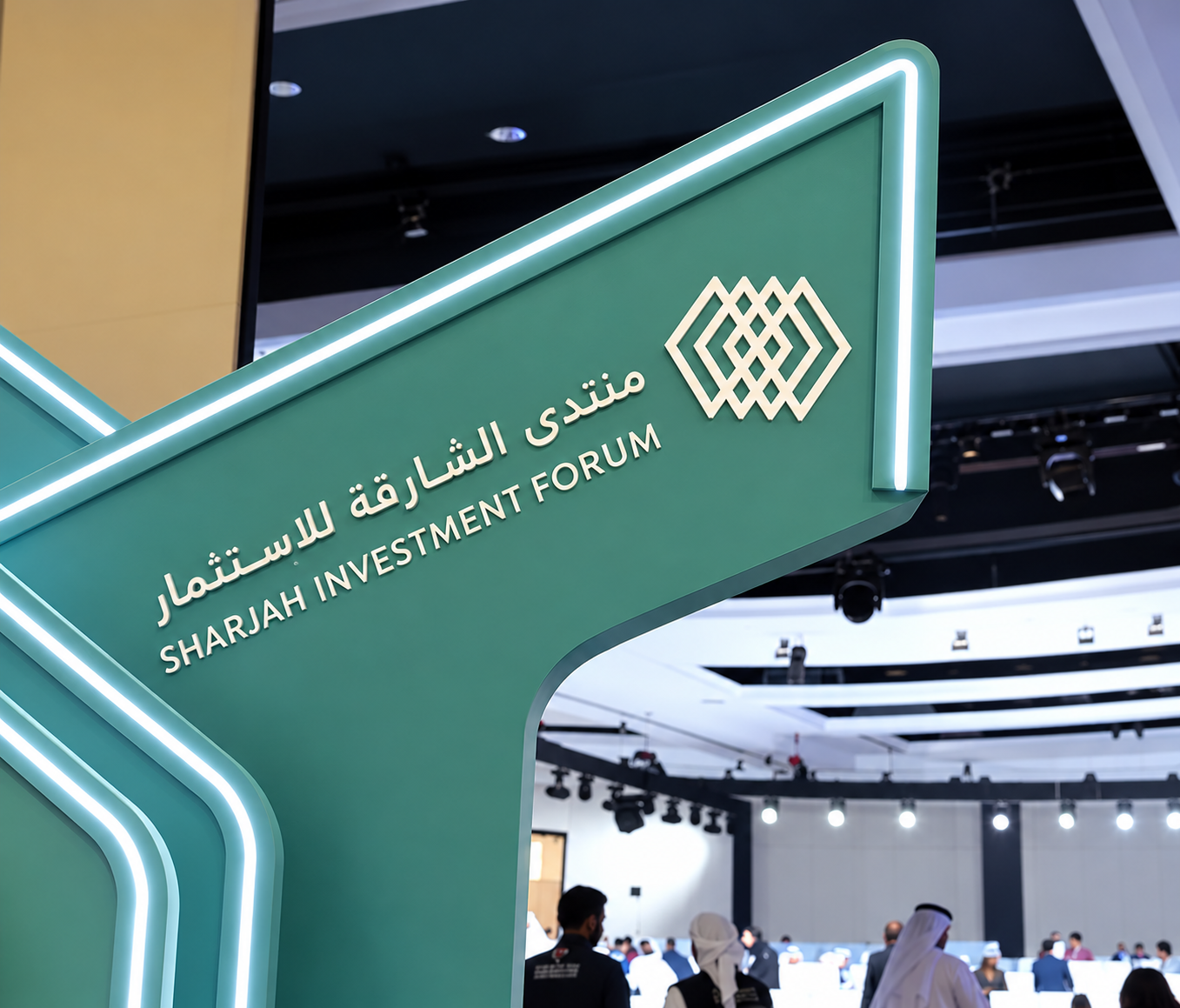
With over 10,000 participants from more than 60 countries, Sharjah Investment Forum 2026 highlighted industrial development, AI-powered investment services and partnerships shaping more adaptable economies.
Economic resilience is no longer defined solely by an economy’s ability to withstand crises. It increasingly depends on its capacity to sustain growth, strengthen industries and respond to changing technologies, capital flows and global supply chains. Against this backdrop, Sharjah Investment Forum 2026 brought together policymakers, business leaders and investors on October 14–15 under the theme “Building Adaptive Economies”. The ninth edition focused on how economic challenges can become opportunities for industrial development, investment and long-term competitiveness.
Sharjah Investment Forum 2026 Attracts Over 10,000 Participants
Organised by the Sharjah FDI Office (Invest in Sharjah) in collaboration with the UAE Ministry of Investment, the two-day forum took place at Al Jawaher Reception and Convention Centre.
The event welcomed more than 10,000 participants from over 60 countries and featured more than 80 speakers, over 140 activities and 80 direct business meetings.
Sessions explored economic leadership, technology, global capital flows, supply-chain resilience and the future of communities, bringing together perspectives from government, investment, industry and entrepreneurship.
The discussions focused on developing economic systems capable of attracting investment, sustaining business growth and maintaining competitiveness amid global change.
Finance & Business participated as an official media partner, supporting coverage of the forum’s discussions and emerging investment priorities.
UAE Industrial Strategy Targets Local Production of Over 5,000 Products
Manufacturing featured prominently in the forum’s discussions, reflecting the growing importance of diversified supply chains and domestic production in strengthening economic resilience.
The UAE Ministry of Industry and Advanced Technology outlined priorities to localise the production of more than 5,000 products across 12 sectors over the coming decade.
The measures presented included an AED 180 billion procurement and offtake package and the AED 1 billion National Industry Resilience Fund, designed to support smaller manufacturers.
These initiatives reflect the UAE’s efforts to expand domestic manufacturing capabilities, strengthen supply-chain reliability and improve industrial competitiveness.
Importantly, the figures represent national programmes and priorities discussed at the forum, rather than investment agreements all signed during the event itself.
Najm AI Agent Connects Investors with Opportunities in Sharjah
Artificial intelligence emerged as a practical tool for improving access to investment opportunities with the launch of Najm, an AI-powered investment agent developed by Invest in Sharjah.
Najm helps investors identify commercial and industrial opportunities that match their project requirements and budgets. Its interactive interface allows users to refine their searches and obtain more detailed information to support investment decisions.
The launch was accompanied by three memoranda of understanding involving the Sharjah Department of Town Planning and Survey, Property Finder and Bayut.
The partnerships aim to improve access to relevant real estate and investment data. Najm’s initial phase focuses on land, factories and industrial facilities, with plans to expand into additional sectors, including education, healthcare and technology.
The initiative demonstrates how AI-powered services can simplify investment research, improve information accessibility and connect investors with relevant opportunities.
Sharjah Real Estate Transactions Reach AED 46.8 Billion
Sharjah’s property market was another major focus of the forum, supported by investment figures highlighting the emirate’s real estate activity.
According to the Sharjah Real Estate Registration Department, the value of real estate transactions reached AED 46.8 billion during the first nine months of 2026, representing a 5.6% increase compared with the corresponding period in 2025.
The market also attracted 9,891 new investors during the same period, while property trading involved investors from 130 nationalities.
These figures reflect Sharjah’s real estate market performance before the forum and should not be interpreted as investment outcomes generated by the event.
The data highlights the role of regulatory clarity, diversified property ownership opportunities and accessible information in supporting investor confidence.
Combined with digital initiatives such as Najm, these developments illustrate Sharjah’s approach to making investment opportunities more accessible to regional and international investors.
Mohamed Alabbar Calls for Quarterly Strategy Reviews
The forum also examined the importance of business leadership in managing economic uncertainty.
Mohamed Alabbar, Founder and Managing Director of Emaar Properties, urged companies to reassess their strategies every three months to respond to changing economic and technological conditions.
He also emphasised financial discipline and maintaining cash reserves during periods of growth to help businesses manage future challenges.
Other discussions focused on stronger corporate governance, investor protection, support for startups beyond their initial establishment, and responsible AI adoption supported by human oversight.
Participants also highlighted the importance of reliable logistics networks, access to financing and international markets, and investment policies that translate into practical support for business expansion.
Building Economic Resilience Beyond the Forum
Sharjah Investment Forum 2026 presented economic resilience as a long-term capability rather than a temporary response to disruption.
Industrial localisation, stronger supply chains, AI-enabled investment services and effective partnerships emerged as interconnected priorities for sustaining economic growth.
For Sharjah, the forum reinforced the emirate’s position as a meeting point for capital, expertise and emerging opportunities, where investment discussions can support practical approaches to economic development. Global uncertainty may persist, but economies that continuously strengthen their capabilities, institutions and investment ecosystems are better positioned to adapt and grow.